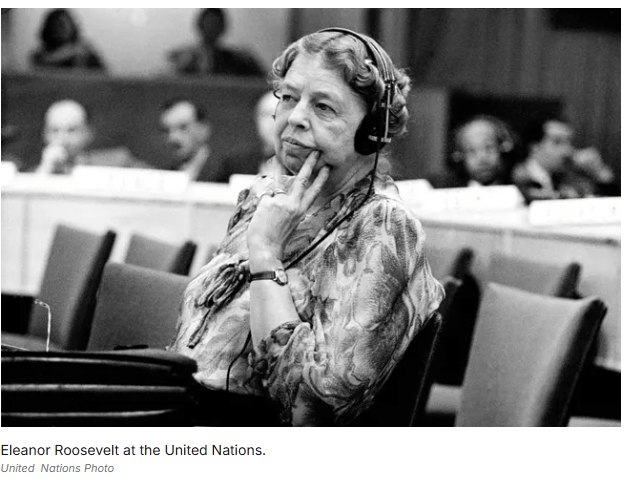
What do we really know about Eleanor Roosevelt?
Most people know the headlines: She was the wife of a President. She was outspoken. She was a published author. She was a global advocate for human rights.
But beneath the public figure was a woman shaped by a childhood that taught her fear long before she ever learned courage.
She grew up in a painful, unstable home. She lost both parents early. She was raised in an environment of criticism and emotional neglect. She learned to shrink, to stay quiet, to disappear into the background. Sound familiar?
She was shy. She was introverted. She was fearful. Again….familiar to many.
And that is exactly why her words about fear still land with such force. Because she wasn’t speaking from theory. She was speaking from experience.
Fear: The Emotion We All Understand
Being afraid is something every one of us understands. Fear is universal. Fear is human. Fear is the quiet companion that walks beside us in moments of uncertainty, transition, and truth-telling.
Eleanor Roosevelt understood this deeply. She lived with fear — not as an occasional visitor, but as a constant presence.
And yet… she became one of the most courageous women of the 20th century.
So how did she make that shift? And more importantly — can we?
How Eleanor Roosevelt Moved From Fearful to Courageous
Eleanor Roosevelt didn’t wake up one day fearless. She didn’t wait for confidence to arrive. She didn’t wait for fear to disappear.
She made a choice.
A choice she made again and again, in small moments and large ones.
1. She chose visibility over hiding
Despite being naturally shy, she held press conferences, gave speeches, wrote a daily column, and traveled the world. Every act of visibility was an act of defiance – not against people or ideals – but against her own fear.
2. She chose purpose over comfort
She stepped into arenas where she knew she would be criticized — civil rights, women’s rights, human rights. Of course, she felt fear. She did it anyway.
3. She chose action over paralysis
Her most famous line — “You must do the thing you think you cannot do” — wasn’t a slogan. It was her personal mantra. And we can borrow it!
4. She chose growth over safety
She believed courage was built through repeated exposure to fear. Every time she faced it, she expanded her capacity, her ability and her influence.
5. She chose meaning over approval
She stopped living for other people’s expectations and started living for her own values.
This is the shift. Not from fear to fearlessness. But from fear to forward movement.
What Her Life Teaches Us About Our Own
Eleanor Roosevelt’s story isn’t about perfection. It’s about possibility.
She teaches us that courage is not the absence of fear — it’s the decision to take action anyway.
She teaches us that fear is not a flaw — it’s a signal. A threshold. A doorway.
She teaches us that the life we want is often waiting on the other side of the thing we’re most afraid to do.
And she teaches us that we don’t have to be fearless to be brave. We just have to be willing.
So What About Us?
We’re all afraid of something. Afraid of failing. Afraid of succeeding. Afraid of being seen. Afraid of being misunderstood. Afraid of telling the truth about our lives. Afraid of stepping into the next version of ourselves.
But Eleanor Roosevelt’s life offers us a map:
- Start where you are.
- Feel the fear.
- Take the step anyway.
- Let courage grow from the doing.
Courage is not a trait. It’s simply a daily practice. Remember…Do one thing every day that scares you. You’ve got this!
 Toni Peters - Author
Leave a comment