
Tag: faith

  • The Fear That Connects Us

    If you shared your story with me, this post is for you. 

    Writing about your life requires a specific kind of courage — the kind that doesn’t roar, but trembles. The kind that doesn’t arrive fully formed, but grows in the cracks left behind by fear. The kind that asks you to tell the truth even when your voice shakes.

    I’ve learned this from the women who have opened their lives to me.

    Women from every walk of life — wealthy, poor, middle-class. Women of different ages, different ethnicities, different histories. Their traumas vary: betrayal, abuse, abandonment, the slow erosion of identity, the sudden collapse of safety, the quiet violence of being unseen.

    Their stories are different. But their fear is the same.

    Fear is the thread that runs through every story I’ve been trusted with. Fear of leaving. Fear of staying. Fear of being believed. Fear of being blamed. Fear of losing everything. Fear of losing themselves.

    And when you strip away the circumstances — whether the trauma was work-related, relationship-related, family-rooted, spiritual, or the kind of trauma that doesn’t have a name but leaves a mark anyway — what remains is the same shared experience:

    Fear.

    Not the dictionary kind. Not the kind you can summarize in a sentence.

    I’m talking about the real thing — the kind that lives in the body.

    Fear that smells like metal and adrenaline. Fear that tightens the belly and crawls up the spine. Fear that narrows the world until all you can see is the next breath. Fear that whispers, “We’ve been here before,” even when the present moment is safe.

    Fear is not weakness. Fear is memory. Fear is the body remembering what the mind has tried to forget.

    And yet — every woman I’ve spoken with kept moving. Sometimes in inches. Sometimes in strides. Sometimes stopping completely until she could gather herself again.

    But always forward.

    Because fear may shape us, but it does not have to decide our fate.

    These women — the ones who trusted me with their stories — have taught me more about courage than any book ever could.

    They taught me that courage is not loud. It’s not glamorous. It’s not a Hollywood moment.

    Courage is a whisper. A breath. A trembling step forward when everything in you wants to freeze.

    Courage is telling the truth about what happened to you. Courage is naming the thing that tried to break you. Courage is choosing yourself — sometimes for the first time in your life.

    Courage is saying, “This happened. And I’m still here.”

    Fear is not an idea. Fear is a presence.

    Fear has a temperature — cold at first, then hot. It has a texture — sharp, metallic, electric. It has a sound — the rush of blood in your ears, the thud of your own heartbeat, the quiet click of your breath catching in your throat.

    Fear sits low in the belly — a tightening, a twisting, a sudden drop like missing a step on the stairs. It crawls up the spine. It settles in the jaw. It clenches the hands.

    Fear narrows the world. It pulls the edges in. It makes the room smaller, the options fewer, the future shorter.

    Fear is the moment the body says, “We’ve been here before.” Even when the mind insists, “We’re safe now.”

    Fear is memory. Fear is instinct. Fear is the echo of every moment when power was taken, trust was broken, or safety was lost.

    Fear is not weakness. Fear is the body remembering.

    And yet — fear is also the moment right before courage.

    A Call to Trauma Survivors

    If you are reading this and you are a survivor — of abuse, betrayal, abandonment, violence, manipulation, neglect, or any trauma that left you questioning your worth — I want you to hear me clearly:

    You are not alone. You are not broken. You are not behind. You are not too much. You are not too late.

    Your fear makes sense. Your pauses make sense. Your survival makes sense.

    And your healing — in inches or in strides — is sacred.

    You do not have to rush. You do not have to explain. You do not have to justify the ways you protected yourself.

    You are allowed to move at the pace your nervous system can hold. You are allowed to rest. You are allowed to rise. You are allowed to rewrite your story.

    And when you’re ready — when the ground feels steady enough beneath your feet — you are allowed to tell your truth.

    Not for the world. Not for validation. Not for applause.

    But for you.

    Because your story matters. 

    And because, as Mary Oliver taught us:

    “Instructions for living a life. Pay attention. Be astonished. Tell about it.”
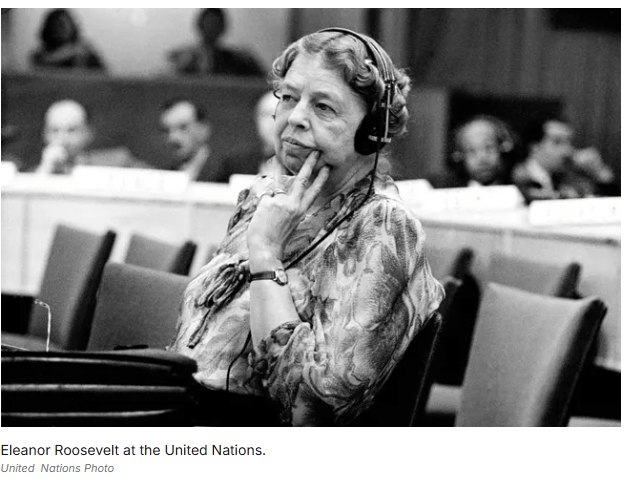
  • More on Eleanor Roosevelt……

    More on Eleanor Roosevelt……

    What do we really know about Eleanor Roosevelt?

    Most people know the headlines: She was the wife of a President. She was outspoken. She was a published author. She was a global advocate for human rights.

    But beneath the public figure was a woman shaped by a childhood that taught her fear long before she ever learned courage.

    She grew up in a painful, unstable home. She lost both parents early. She was raised in an environment of criticism and emotional neglect. She learned to shrink, to stay quiet, to disappear into the background. Sound familiar?

    She was shy. She was introverted. She was fearful. Again….familiar to many.

    And that is exactly why her words about fear still land with such force. Because she wasn’t speaking from theory. She was speaking from experience.

    Fear: The Emotion We All Understand

    Being afraid is something every one of us understands. Fear is universal. Fear is human. Fear is the quiet companion that walks beside us in moments of uncertainty, transition, and truth-telling.

    Eleanor Roosevelt understood this deeply. She lived with fear — not as an occasional visitor, but as a constant presence.

    And yet… she became one of the most courageous women of the 20th century.

    So how did she make that shift? And more importantly — can we?

    How Eleanor Roosevelt Moved From Fearful to Courageous

    Eleanor Roosevelt didn’t wake up one day fearless. She didn’t wait for confidence to arrive. She didn’t wait for fear to disappear.

    She made a choice.

    A choice she made again and again, in small moments and large ones.

    1. She chose visibility over hiding

    Despite being naturally shy, she held press conferences, gave speeches, wrote a daily column, and traveled the world. Every act of visibility was an act of defiance – not against people or ideals – but against her own fear.

    2. She chose purpose over comfort

    She stepped into arenas where she knew she would be criticized — civil rights, women’s rights, human rights. Of course, she felt fear. She did it anyway.

    3. She chose action over paralysis

    Her most famous line — “You must do the thing you think you cannot do” — wasn’t a slogan. It was her personal mantra. And we can borrow it!

    4. She chose growth over safety

    She believed courage was built through repeated exposure to fear. Every time she faced it, she expanded her capacity, her ability and her influence.

    5. She chose meaning over approval

    She stopped living for other people’s expectations and started living for her own values.

    This is the shift. Not from fear to fearlessness. But from fear to forward movement.

    What Her Life Teaches Us About Our Own

    Eleanor Roosevelt’s story isn’t about perfection. It’s about possibility.

    She teaches us that courage is not the absence of fear — it’s the decision to take action anyway.

    She teaches us that fear is not a flaw — it’s a signal. A threshold. A doorway.

    She teaches us that the life we want is often waiting on the other side of the thing we’re most afraid to do.

    And she teaches us that we don’t have to be fearless to be brave. We just have to be willing.

    So What About Us?

    We’re all afraid of something. Afraid of failing. Afraid of succeeding. Afraid of being seen. Afraid of being misunderstood. Afraid of telling the truth about our lives. Afraid of stepping into the next version of ourselves.

    But Eleanor Roosevelt’s life offers us a map:

    • Start where you are.
    • Feel the fear.
    • Take the step anyway.
    • Let courage grow from the doing.

    Courage is not a trait. It’s simply a daily practice. Remember…Do one thing every day that scares you. You’ve got this!

  • The Fear That Connects Us
If you shared your story with me – this post is for you.

    The Fear That Connects Us If you shared your story with me – this post is for you.

    Writing about your life requires a specific kind of courage — the kind that doesn’t roar, but trembles. The kind that doesn’t arrive fully formed, but grows in the cracks left behind by fear. The kind that asks you to tell the truth even when your voice shakes.

    I’ve learned this from the women who have opened their lives to me.

    Women from every walk of life — wealthy, poor, middle-class. Women of different ages, different ethnicities, different histories. Their traumas vary: betrayal, abuse, abandonment, the slow erosion of identity, the sudden collapse of safety, the quiet violence of being unseen.

    Their stories are different. But their fear is the same.

    Fear is the thread that runs through every story I’ve been trusted with. Fear of leaving. Fear of staying. Fear of being believed. Fear of being blamed. Fear of losing everything. Fear of losing themselves.

    And when you strip away the circumstances — whether the trauma was work-related, relationship-related, family-rooted, spiritual, or the kind of trauma that doesn’t have a name but leaves a mark anyway — what remains is the same shared experience:

    Fear.

    Not the dictionary kind. Not the kind you can summarize in a sentence.

    I’m talking about the real thing — the kind that lives in the body.

    Fear that smells like metal and adrenaline. Fear that tightens the belly and crawls up the spine. Fear that narrows the world until all you can see is the next breath. Fear that whispers, “We’ve been here before,” even when the present moment is safe.

    Fear is not weakness. Fear is memory. Fear is the body remembering what the mind has tried to forget.

    And yet — every woman I’ve spoken with kept moving. Sometimes in inches. Sometimes in strides. Sometimes stopping completely until she could gather herself again.

    But always forward.

    Because fear may shape us, but it does not have to decide our fate.

    These women — the ones who trusted me with their stories — have taught me more about courage than any book ever could.

    They taught me that courage is not loud. It’s not glamorous. It’s not a Hollywood moment.

    Courage is a whisper. A breath. A trembling step forward when everything in you wants to freeze.

    Courage is telling the truth about what happened to you. Courage is naming the thing that tried to break you. Courage is choosing yourself — sometimes for the first time in your life.

    Courage is saying, “This happened. And I’m still here.”

    Fear is not an idea. Fear is a presence.

    Fear has a temperature — cold at first, then hot. It has a texture — sharp, metallic, electric. It has a sound — the rush of blood in your ears, the thud of your own heartbeat, the quiet click of your breath catching in your throat.

    Fear sits low in the belly — a tightening, a twisting, a sudden drop like missing a step on the stairs. It crawls up the spine. It settles in the jaw. It clenches the hands.

    Fear narrows the world. It pulls the edges in. It makes the room smaller, the options fewer, the future shorter.

    Fear is the moment the body says, “We’ve been here before.” Even when the mind insists, “We’re safe now.”

    Fear is memory. Fear is instinct. Fear is the echo of every moment when power was taken, trust was broken, or safety was lost.

    Fear is not weakness. Fear is the body remembering.

    And yet — fear is also the moment right before courage.

    A Call to Trauma Survivors

    If you are reading this and you are a survivor — of abuse, betrayal, abandonment, violence, manipulation, neglect, or any trauma that left you questioning your worth — I want you to hear me clearly:

    You are not alone. You are not broken. You are not behind. You are not too much. You are not too late.

    Your fear makes sense. Your pauses make sense. Your survival makes sense.

    And your healing — in inches or in strides — is sacred.

    You do not have to rush. You do not have to explain. You do not have to justify the ways you protected yourself.

    You are allowed to move at the pace your nervous system can hold. You are allowed to rest. You are allowed to rise. You are allowed to rewrite your story.

    And when you’re ready — when the ground feels steady enough beneath your feet — you are allowed to tell your truth.

    Not for the world. Not for validation. Not for applause.

    But for you.

    Because your story matters. 

    And because, as Mary Oliver taught us:

    “Instructions for living a life. Pay attention. Be astonished. Tell about it.”
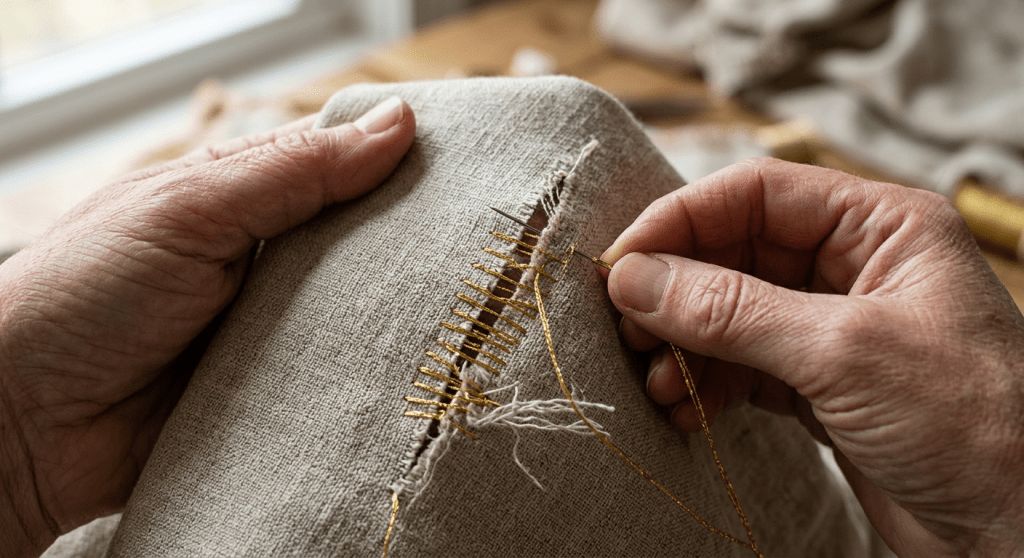
  • “Never Let fear decide your fate”

    Part 2 of the Go at it Boldly Series

    Five months ago, I hung a notecard on my wall with a quote from Basil King — a man who lived more than a century ago, who wrestled with illness, fear, and faith, and who wrote from the depths of his own uncertainty. His words became a daily ritual for me:

    “Go at it boldly, and you’ll find unexpected forces closing round you and coming to your aid.”

    That sentence taught me to imagine courage as a circle of protection and helped me move forward when everything in me wanted to freeze.

    But boldness is only the first step.

    Because even when we choose boldness, unfortunately, fear doesn’t disappear.  Instead, it whispers in our ear. It even tries to bargain its way back into the driver’s seat.

    And that’s where the next quote entered my life.

    A Modern Voice for a Modern Fear

    The line comes from Morgan Benton, a contemporary writer who shared her work on Medium. She’s not a philosopher or a literary icon. She’s a woman who wrote honestly about anxiety, healing, eating disorders, relationships, and the daily work of choosing courage over collapse.

    Her writing is raw, present, and deeply human — the kind of truth that comes from someone still in the middle of their own becoming.

    And in one of her essays, she wrote:

    “Never let your fear decide your fate.”

    A simple sentence.
    A modern echo of Basil King’s wisdom.
    A reminder that fear may speak — but it does not get to choose.

    When I first read Morgan’s words, something in me relaxed.  Here was a woman writing from the trenches of her own healing, saying out loud what so many of us feel:

    Fear lies.

    Fear is loud.
    Fear is convincing.
    Fear even sometimes feels like safety — even when it’s not.

    And yet…Fear has never once led me toward the life I want.

    So I added Morgan’s quote to my wall, right next to Basil King’s. On purpose.
    Two voices separated by a century.
    Two people who knew fear intimately.
    Two reminders that courage is not a one‑time decision — it’s a daily practice.

    Basil King tells me:
    Move. Step forward. Be bold. Help will meet you.

    Morgan Benton tells me:
    And when fear tries to reroute you… don’t hand it the map.

    Together, they form a kind of spiritual choreography:

    1. Choose boldness.
    2. Refuse to let fear choose for you.
    3. Trust that support will rise to meet your courage.

    This is the rhythm I’ve been living in as a first‑time author — navigating contracts, feedback, revisions, uncertainty, and the emotional excavation that comes with writing a memoir.

    I’ve heard fear in my own ear.  It’s told me:

    • “You don’t know enough about publishing.”
    • “You’re not ready.”
    • “What if you get it wrong?”
    • “What if people misunderstand your story?”
    • “What if your book is a failure and you help no one?”

    But every time I’ve chosen boldness instead of fear, something unexpected has shown up:

    • clarity
    • support
    • opportunities
    • people
    • alignment
    • the next right step (even when it’s a tiny step)

    Those are the “unexpected forces” Basil King promised.
    Those are the outcomes Morgan Benton’s quote protects.

    What I Wish I Could Tell Morgan Benton

    I wish I could sit with her the way I wish I could sit with Basil King — two writers who shaped my courage in different ways.

    I’d tell her: “Your sentence helped me choose myself when fear tried to choose for me.”

    And maybe that’s the real beauty of her quote:
    It wasn’t written from a mountaintop.
    It was written from the middle of the climb.

    Every morning, I look at both notecards on my wall.

    One reminds me to move boldly.
    The other reminds me not to let fear steer.

    And together, they’ve become a kind of mantra for this season of my life:

    Go at it boldly.
    Never let your fear decide your fate.
    And trust that what you need will meet you on the path.

    Because it always has.
    And I believe it always will.

  • “Go at it boldly…”: The Quote That Has Been Carrying Me Forward

    There’s a notecard hanging on my wall right now. It’s simple — just a few handwritten words — but it has become a kind of compass for me these past five months.

    “Go at it boldly, and you’ll find unexpected forces closing round you and coming to your aid.”Basil King

    I read it every morning. I meditate on it. I feel it in my body. And then I imagine it — those “unexpected forces” gathering around me like a sacred circle, securing me, steadying me, partnering with me as I move forward on this wild, vulnerable journey of becoming an author.

    What I didn’t know when I first fell in love with this quote is that the man who wrote it, William Benjamin Basil King, understood fear and uncertainty in a way that feels eerily familiar.

    Basil King was a Canadian clergyman born in 1859, a man raised in a strict religious environment who devoted the first half of his life to ministry. He was intelligent, sensitive, spiritually attuned — and then, in his early forties, everything changed.

    Illness struck. His eyesight began to fail. His thyroid disease worsened. He could no longer preach, no longer lead, no longer do the work he believed he was put on earth to do.

    He entered a long season of fear, depression, and uncertainty — the kind of season that strips a person down to their essence.

    And in that darkness, he began to write.

    His most enduring book, The Conquest of Fear, is where this quote comes from. It wasn’t written from a mountaintop. It wasn’t written by someone who had conquered life. It was written by a man who was fighting for his own courage, one day at a time.

    That’s why the line hits so deeply. It’s not motivational fluff. It’s lived truth.

    When I first read King’s words, I felt something shift. I was in the early stages of my own author journey — full of hope, yes, but also full of the kind of fear that whispers, “Who do you think you are?”

    I didn’t know what was ahead of me. I didn’t know how to navigate contracts or publishing paths. I didn’t know how to hold the enormity of writing a book that asks me to tell the truth about my life.

    But I knew this: I wanted to move forward boldly, even if my voice shook.

    So I wrote the quote on a notecard and hung it where I would see it every day. And slowly, something began to happen.

    I started imagining those “unexpected forces” King wrote about — not as magic, but as alignment. As people showing up at the right time. As opportunities unfolding. As clarity arriving when I needed it most. As the quiet sense that I wasn’t walking this path alone.

    And I wasn’t.

    Sometimes I wish I could sit across from Basil King — this man who wrestled with fear, illness, faith, and resilience — and tell him what his words have meant to me.

    I wish I could ask him what it felt like to lose the life he thought he was meant to live. I wish I could hear how he found his way through the dark. I wish I could thank him for writing from the middle of his struggle instead of waiting for the end of it.

    Because that’s what his quote reminds me of every day: Courage isn’t the absence of fear. It’s the willingness to move anyway — trusting that help will meet you on the path.

    For me, boldness has become less about bravado and more about devotion. A daily choice. A quiet ritual.

    I read the quote. I breathe it in. I imagine the forces gathering. And then I take the next step — sometimes small, sometimes shaky, but always forward.

    And every time I do, something meets me. A person. A resource. A moment of clarity. A reminder that I’m not doing this alone.

    Maybe that’s what Basil King was trying to tell us: When we move with intention, the world moves with us.